
Why Your Business Website Isn’t Getting You Clients (And How to Fix It)
Your website is live — so why aren’t leads coming in? We break down the 7 most common reasons small business websites fail to convert and what to fix first.
If your business website not getting clients is frustrating you, you’re not alone — and there’s almost always a fixable reason.
Plopjoy · Web Strategy
You paid for the website. It’s live. It looks decent. So why is your business website not getting clients? Here’s exactly what’s wrong — and what you need to fix before spending another dollar on ads.
Most business websites not getting clients don’t fail because they’re ugly. They fail because they were built for a portfolio shot, not to generate leads. There’s a difference between a website that exists and one that works. If you’re getting traffic but no inquiries — or worse, no traffic at all — one or more of these seven problems is the reason.
Why Is Your Business Website Not Getting Clients? Start Here
When someone lands on your site, they make a decision in under five seconds: is this for me? If your headline says something like “Welcome to [Business Name]” or “Excellence in Service Since 2009,” you’ve already lost them.
Your homepage headline needs to answer three things immediately: what you do, who you serve, and where you serve them. Example: “Whole-Home Water Softener Installation in Central Texas — Done in One Day.” That headline tells me everything. I know if I’m in the right place in two seconds.
Rewrite your above-the-fold headline to include: your service + your location + a clear outcome or differentiator. Test it by asking someone who doesn’t know your business to read it cold and tell you what you do.
2. You Have No Clear Call-to-Action
A visitor who doesn’t know their next step will leave. This is called decision paralysis, and it’s killing your conversions. If your site has five different CTAs — “Call Us,” “Learn More,” “View Gallery,” “Get a Quote,” “Schedule Online” — all competing for attention, your visitor will choose none of them.
Pick one primary CTA per page. For most service businesses, that’s either a phone number click-to-call or a short contact/quote form. Make it visible above the fold and repeat it at the bottom of every page.
Audit every page. Each page should have one dominant CTA button in a contrasting color. Remove or demote every other competing link near that button.
3. Your Site Loads Too Slowly on Mobile
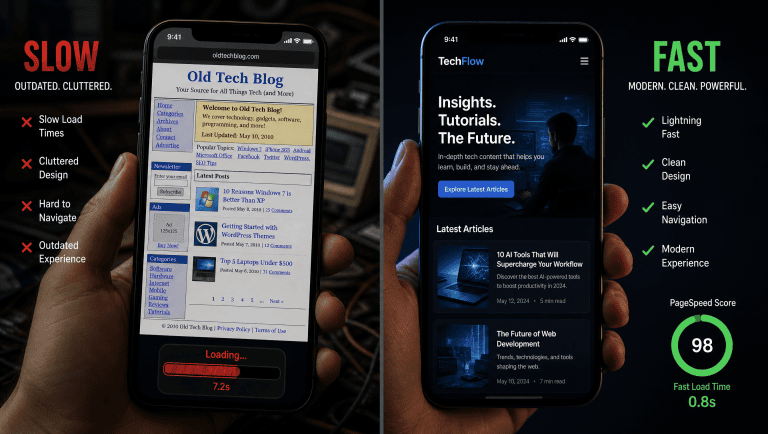
Over 60% of local service searches happen on a phone. If your site takes more than 3 seconds to load on mobile, more than half of your visitors have already bounced — before they ever saw your offer. Google also uses mobile speed as a ranking factor, so a slow site hurts you in search before anyone even clicks.
The most common culprit: uncompressed images uploaded straight from a phone or camera. A 4MB JPEG of your work van does not need to be on your homepage.
Run your site through PageSpeed Insights. Convert all images to WebP and compress them below 150KB. Install a caching plugin if you’re on WordPress.
4. You’re Not Showing Up on Google at All
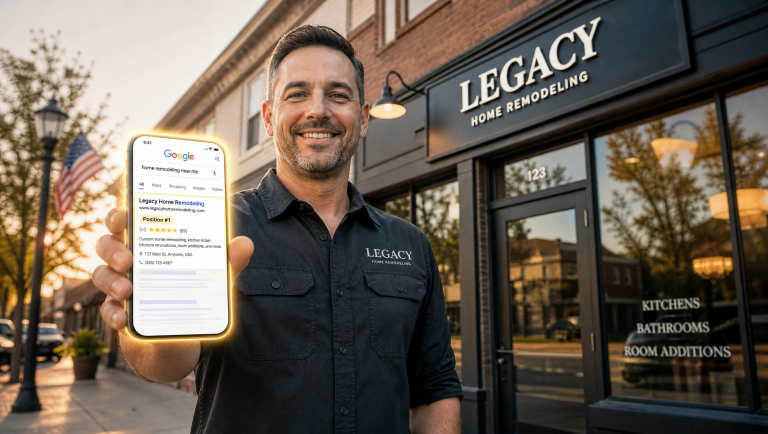
A beautiful website sitting on page 3 of Google is the same as no website at all. If you haven’t done any SEO work — no keyword-optimized pages, no local content, no Google Business Profile linked — your website is invisible to the people actively searching for what you sell.
Local SEO isn’t rocket science, but it requires intentional structure. Your pages need to target specific search phrases, your site needs to load fast, and your Google Business Profile needs to be complete and active.
Search Google for your main service + city right now. If you’re not on page 1, you need dedicated local landing pages, schema markup, and a consistent content strategy. This is exactly what we build for clients at Plopjoy.
5. There’s No Social Proof Above the Fold
People don’t trust businesses they’ve never heard of — they trust businesses other people have vouched for. If your homepage has no reviews, no ratings, no customer photos, no case studies, no “as seen in” logos — you’re asking a stranger to trust you with their money and their home.
Social proof doesn’t have to be elaborate. Even three sentences from a real customer with their first name and city will outperform a wall of marketing copy.
Add a Google Reviews widget, a star rating badge, or 2–3 short testimonials with attribution to your homepage, as close to the top as possible. Pull them from your existing Google Business Profile reviews if you have them.
6. Your Contact Form Is Buried or Broken
This happens more than you’d think. A client came to us with a site that had been live for eight months. Their contact form was sending submissions to an email address that no longer existed. They had no idea. Every lead that tried to reach them got silence.
Even when forms work, they’re often on a separate “Contact” page that takes three clicks to find. By the time a visitor gets there, they’ve lost momentum.
Test your contact form right now. Submit a test entry and confirm you receive it. Then add a short inline contact form directly on your homepage — not just in the nav or footer.
7. You’re Talking About Yourself Instead of the Client’s Problem
Read your homepage copy. How many sentences start with “We” or “Our”? Most service business websites spend 80% of their words talking about themselves — their history, their team, their process — and almost nothing about the customer’s problem and how they solve it.
Customers don’t care about your company. They care about their problem. The site that wins is the one that makes the visitor feel understood first, then presents the solution.
Rewrite your homepage opening to start with their pain: “Tired of chasing down leads that go cold?” or “Sick of paying for ads that don’t convert?” Lead with the problem, then position yourself as the solution.
What a Business Website Not Getting Clients Is Missing
A website that generates leads isn’t necessarily the most beautiful one. It’s the one that loads fast, speaks directly to the right customer, has a clear next step, and shows up in search. Those four things together — speed, clarity, CTA, and visibility — are what separate a website that pays for itself from one that’s just a business card nobody reads.
If your business website not getting clients is an ongoing problem, it’s almost always fixable. Read our guides on getting your business on Google and what every service business website needs to start driving real leads.
If your website has one or more of these problems, it’s costing you leads every single day. We do a free site audit — we’ll look at your current site, tell you exactly what’s broken, and show you what a fixed version would generate for your business.