WordPress vs. Custom Website: Which Is Right for Your Business?
Debating WordPress or a fully custom-built site? Here’s an honest breakdown of costs, capabilities, and which one actually makes sense for your business size and goals.
Plopjoy · Web Strategy
Ultimately, every small business owner faces the WordPress vs custom website for business question — and it’s one we help clients navigate every week at Plopjoy. We’ve built both, and the honest answer isn’t what most web agencies want you to hear.
The WordPress vs custom website for business debate gets murkier every year as WordPress grows more capable and custom frameworks become more accessible. Here’s what actually matters when making this decision — based on real client outcomes, not which platform we’d rather build on.
What “Custom Website” Actually Means
When people say “custom website,” they usually mean one of two things: a WordPress site with a custom design (no pre-made template), or a site built entirely in code without WordPress — typically React, Next.js, or a similar framework. These are very different things with very different costs.
For most small and medium service businesses, the comparison that matters is: a well-built WordPress site vs. a coded custom site from scratch.
The Case for WordPress
A complete professional WordPress site — custom design, on-page SEO, contact forms, fast hosting — typically costs $2,000–$8,000. A comparable coded custom site starts at $10,000 and goes up fast.
WordPress was built for non-developers. You can add a blog post, update your hours, add photos, or change a button without touching code or calling a developer every time.
SEO tools, booking systems, CRMs, e-commerce, payment processing, review management — almost everything you need exists as a WordPress plugin, often free or cheap.
With Yoast or Rank Math, WordPress gives you full control over title tags, meta descriptions, schema markup, sitemaps, and canonical URLs without custom development.
The Case for a Custom-Coded Site
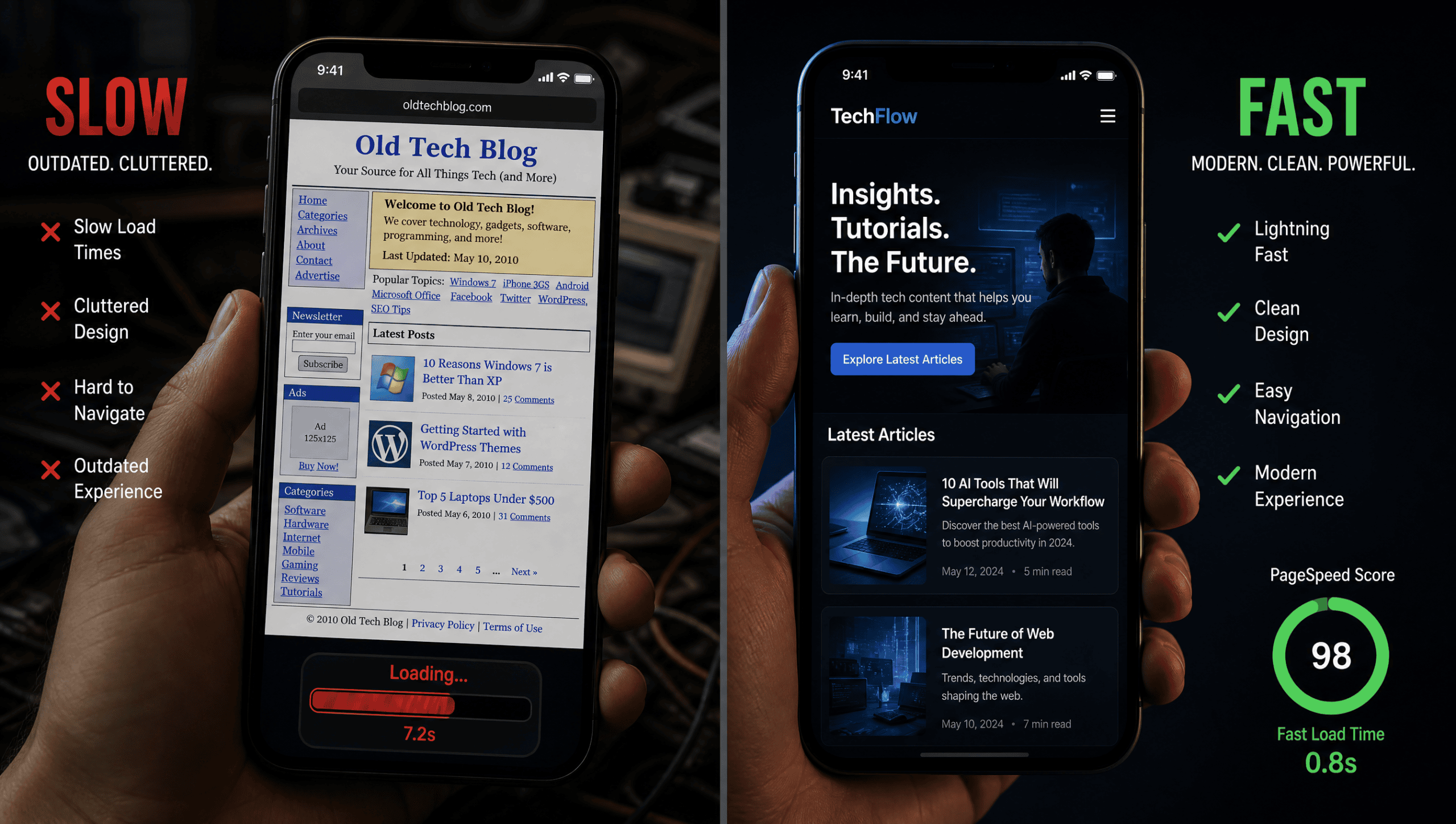
A coded site in Next.js or Astro, built correctly, will load faster than a WordPress site — no plugin overhead, no database queries, full control over every byte. If perfect PageSpeed scores matter to your business model, custom code gets you there more reliably.
WordPress plugins are a security surface. A custom-coded site with no plugin dependencies has a smaller attack surface and no “plugin broke everything” scenarios after updates.
Custom code can do anything. Unique animations, complex interactions, non-standard layouts — if you need pixel-perfect control over every element, custom code is the only path that doesn’t involve fighting a framework.
WordPress vs Custom Website for Business: The Honest Comparison
| Factor | WordPress | Custom Coded |
|---|---|---|
| Avg. Build Cost | $2,000–$8,000 | $10,000–$50,000+ |
| Time to Launch | 2–6 weeks | 3–6 months |
| Can You Edit It? | Yes, easily | Needs a developer |
| SEO Capability | Excellent (with Yoast/RankMath) | Excellent (if built right) |
| Speed | Good (90+ with optimization) | Excellent (98–100 possible) |
| Security | Good (requires maintenance) | Better (fewer attack surfaces) |
| Best For | Most small/medium businesses | SaaS, complex apps, high-traffic brands |
Our Recommendation: WordPress vs Custom Website for Business
SEO: The Hidden Factor in WordPress vs Custom Website for Business
One thing most business owners overlook in the WordPress vs custom website for business decision is long-term SEO. WordPress has a major edge — the SEO plugin ecosystem, built-in schema support, and easy content management make it far simpler to keep your site optimized without a developer on retainer.
Custom-coded sites can absolutely be fully SEO-optimized. However, every update to meta data, structured data, or sitemaps typically requires developer involvement. Consequently, for most small businesses, that friction means it simply doesn’t get done consistently.
The Long-Term Maintenance Reality
On the maintenance side, WordPress requires regular plugin and core updates — monthly at minimum. According to W3Techs, WordPress powers over 43% of all websites on the internet, which means an enormous support community and security response infrastructure. Skip these and you open yourself to security vulnerabilities. By contrast, custom sites avoid plugin bloat but need a developer for any meaningful change, which adds real cost over time.
The Bottom Line for Local Service Businesses
Therefore, for a local service business doing $250K–$1M per year, the right answer is almost always a well-built WordPress site. The platform is mature, the tooling is excellent, and the cost-to-capability ratio is hard to beat. Furthermore, the ecosystem ensures long-term support and security. Nevertheless, a custom build makes sense once you’ve genuinely outgrown what WordPress can do.
→ WordPress. You need fast time-to-market, easy content management, full SEO capability, and a budget that leaves room for marketing. WordPress handles all of this without the overhead of custom development.
→ WordPress + WooCommerce, or Shopify. Both give you the product management, payment, and SEO infrastructure you need without starting from scratch.
→ Custom code. If your website IS the product — or needs to interact deeply with a database, API, or custom logic — custom development is the right path.
→ Headless WordPress or custom. Use WordPress as a content management backend while serving content through a fast frontend framework. Best of both worlds, higher cost.
Before deciding, you may also want to read our guide on why most business websites don’t get clients and our guide to getting your small business on Google.
Not sure which direction makes sense for your specific business? We’ll talk through it with you — no pitch, no pressure. We’ll tell you exactly what we’d build and why, based on your goals and budget.