Why AI Website Builders Are Selling You a Beautifully Broken Product
We’ve spent years in the web industry watching technology promises collide with business reality. At Plopjoy, we’ve built on nearly every platform that exists — and we’ve learned the hard way that the shiniest new tool is almost always the one that costs you the most. AI website builders are this generation’s version of that…
We've spent years in the web industry watching technology promises collide with business reality. At Plopjoy, we've built on nearly every platform that exists — and we've learned the hard way that the shiniest new tool is almost always the one that costs you the most. AI website builders are this generation's version of that trap. And the entrepreneurs buying in don't know what they're missing until Google does.
Let's be direct with you
Our team has been in this industry long enough to watch businesses get burned by Flash sites in the early 2000s, by template-mill agencies in the 2010s, and now — in 2026 — by an entire ecosystem of AI builders promising "a website in minutes." Platforms like Base44, Lovable, Bolt, Framer AI, Durable, Wix ADI, Squarespace AI, and Webflow AI are everywhere. The pitch is seductive. The result, for most small business owners, is a disaster in slow motion.
They're getting a website. They're not getting a business asset.
There is a fundamental difference between a website that exists and a website that works. The AI builder industry has mastered the former and almost completely ignored the latter. What follows is not a hot take. It is the considered assessment of a team that has built, broken, analyzed, and rebuilt websites across dozens of platforms — including a firsthand, expensive lesson with one of the most-hyped AI builders on the market.
|
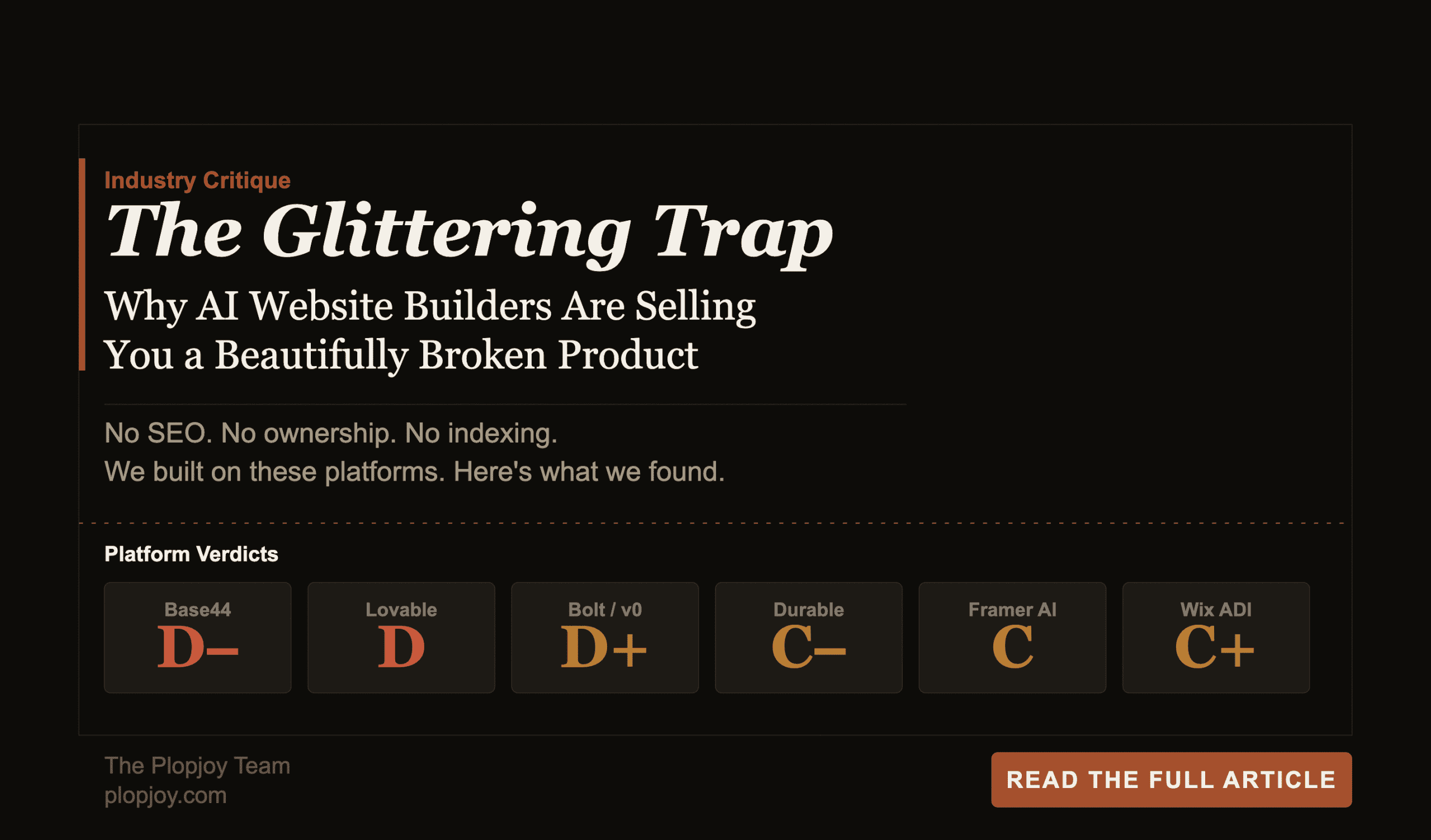
Base44
D−
No SSR · No indexing · We paid $1,600+ to learn this
|
Lovable
D
Beautiful React shell · invisible to Google
|
Bolt / v0
D+
Dev-first · not business-first
|
|
Durable
C−
Generic copy · zero local SEO
|
Framer AI
C
Design-led · SEO bolted on
|
Wix ADI
C+
Most complete · still shallow
|
The SEO problem is not a minor footnote — it is a fatal flaw
Search Engine Optimization is not a marketing department add-on. It is the infrastructure that connects your business to the people who are already looking for you. Every day your website is invisible to Google is a day your competitor — who invested in a real web presence — is collecting those customers instead.
Most AI website builders generate single-page applications (SPAs) or client-side rendered React apps. This is a catastrophic choice for any business that needs to be found organically. Here is what actually happens when Google's crawler visits one of these sites:
- The crawler requests the page and receives a nearly empty HTML document — a single
<div id="root"></div>and a JavaScript bundle. - Google must then execute that JavaScript to render the content. This process is deprioritized, delayed, and inconsistent. Many pages are never fully indexed at all.
- Title tags, meta descriptions, H1 headers, schema markup, Open Graph data — all of these must be dynamically injected, and on most AI builder platforms, they either cannot be customized at all or require workarounds that average users will never implement.
- Page speed scores — a direct Google ranking factor since 2021 — crater on JavaScript-heavy SPAs. We're talking Core Web Vitals scores in the 30s and 40s out of 100, on sites that look beautiful in a browser.
- Canonical URLs, pagination, robots.txt control, XML sitemaps — most platforms either auto-generate these poorly or don't expose them to users at all.
Our real-world experience
We built a full client site on Base44. Hundreds of hours. A complete digital storefront with products, portfolio pages, service pages — the works. Then we submitted it to Google Search Console and watched. The pages were not being indexed. The reason? Base44 has no server-side rendering. Google could not read the content. We migrated the entire site to WordPress on InMotion Hosting, rebuilt it in Elementor Pro, and started over. The refund from Base44 was over $1,600. The real cost — in time, momentum, and delayed revenue — was far greater. We are sharing this so you don't make the same mistake.
It goes far beyond SEO: the complete list of what's missing
The SEO problem alone should disqualify these platforms for most business use cases. But when you dig deeper, the missing features compound into a picture of tools that were built to impress in a demo — not to serve a real business over time.
- No local SEO infrastructure. For any business serving a geographic area, local SEO is the highest-ROI channel available. That means location pages, Google Business Profile integration, NAP consistency, local schema markup, and city-specific landing pages. None of the major AI builders support this at any meaningful depth.
- No schema markup. Structured data tells Google exactly what your business is, what you sell, what your hours are, and what your reviews say. Schema markup for services, products, FAQs, local businesses, and articles is what gets you rich snippets in search results. AI builders either ignore this entirely or generate it incorrectly.
- No real content architecture. AI builders generate copy. They do not generate content strategy. There is no thought given to topical authority, keyword clustering, internal linking structure, pillar pages, or the hundreds of small editorial decisions that separate a website that ranks from one that doesn't.
- Shallow or locked CMS functionality. Real businesses need to publish articles, update service pages, add team members, refresh portfolio items, and respond to seasonal changes. Most AI builder CMSs are either too rigid, too fragile, or locked behind proprietary interfaces that trap your content.
- Proprietary hosting lock-in. When you build on Base44, Lovable, or Framer, your site lives on their infrastructure. If they raise prices, change terms, get acquired, or shut down — your site goes with them. You own nothing. WordPress on your own hosting means you own everything.
- No serious e-commerce foundation. AI builders with e-commerce features are playing pretend. WooCommerce alone has over 800 extensions. The payment gateways, tax logic, inventory management, subscription systems, digital download security, and coupon engine that real online stores need simply do not exist on these platforms.
- No performance optimization pipeline. Image compression, lazy loading, CDN configuration, caching layers, critical CSS, font subsetting — these are the unsexy technical decisions that determine whether your site loads in 1.2 seconds or 4.8 seconds. On AI builders, these are either auto-managed (poorly) or completely inaccessible.
- No ADA/WCAG accessibility compliance. The Americans with Disabilities Act has been applied to websites through litigation since 2019. AI-generated sites routinely fail accessibility audits — missing alt text, poor color contrast, broken focus management, absent ARIA labels. This is both an ethical failure and a legal liability.
- No serious analytics integration. Google Analytics 4, Google Tag Manager, Facebook Pixel, LinkedIn Insight Tag, heat mapping, scroll depth — real digital marketing runs on data. AI builders' "analytics" is a vanity dashboard that tells you how many people visited. It does not tell you where they came from, what they did, or why they left.
- Generic, AI-written copy that performs poorly. The copy these platforms generate is grammatically correct and completely devoid of personality, specificity, or conversion strategy. It reads like what it is: a language model filling in a template. Google increasingly penalizes thin, low-value content. Your customers notice immediately that nobody real wrote it.
"A website that cannot be found by Google is not a digital asset. It is a digital decoration."
Why these platforms exist — and who they actually serve
We are not saying the founders of these companies are malicious. They are building for a market that is real — people who want a web presence quickly and cheaply, and who do not have the technical background to evaluate what they are actually getting.
These tools are exceptional for prototyping. They are excellent for internal tools. Bolt and v0 are genuinely powerful for developers who understand their limitations and use them as scaffolding, not final products. Framer makes beautiful portfolio sites for designers and creatives who don't need to rank for anything.
The problem is not the tool. The problem is the marketing. These platforms are sold to small business owners as legitimate business websites. The homepage says "get your business online in minutes." The implication is that what you get is a complete, functional digital business presence. That implication is false.
The honest version of the pitch
"Build a good-looking prototype that will impress your friends, fail to appear in Google search results, lack any serious e-commerce capability, trap your content in our proprietary system, and need to be completely rebuilt in 18 months when you realize none of this is working."
What a real website actually requires
The fundamentals have not changed. They have only become more sophisticated. A website that actually works for a business in 2026 requires:
- Server-side rendering or static site generation, so content is readable by crawlers without JavaScript execution.
- A properly configured technical SEO foundation: sitemaps submitted to Search Console, canonical tags, robots.txt, structured data, and per-page meta control.
- A content management system the owner can actually use — without breaking the site, without calling a developer, and without proprietary lock-in.
- Hosting on infrastructure you control — or at minimum, hosting with portability guarantees and SLA-backed uptime.
- Page performance that passes Core Web Vitals: Largest Contentful Paint under 2.5 seconds, Cumulative Layout Shift under 0.1, Interaction to Next Paint under 200ms.
- A real e-commerce layer if products are being sold — with proper payment processing, tax compliance, inventory management, and order fulfillment integration.
- ADA compliance — not as an afterthought, but as a design requirement from day one.
- Analytics that actually inform decisions: GA4 properly configured, conversion tracking, event tagging, and a baseline understanding of traffic sources.
The lesson we keep watching entrepreneurs learn the hard way
Every week we talk to business owners who spent $200–$500 on an AI-built website, wondered why no customers were finding them, then spent another $2,000–$10,000 rebuilding from scratch on a real platform. The initial savings evaporated. The months lost to a website that wasn't working for them — those never come back.
The most expensive website is the one you have to build twice. The second most expensive is the one that looks finished but doesn't work.
At Plopjoy, we are not resistant to new technology. We are early movers by nature — we've built on new platforms, new tools, and new channels before most people knew they existed. We are resistant to new technology that doesn't do what it claims. And right now, AI website builders are claiming to be something they are not.
Until the day these platforms build in server-side rendering, real SEO tooling, proper schema support, portable hosting, serious e-commerce, and content architecture — they are selling you a beautiful picture of a house that nobody can find, and that you do not own.
The bottom line from the Plopjoy team
Use AI builders to prototype, to sketch, to impress a stakeholder before a meeting. Then build your real business on WordPress, Webflow with proper SSR, or a custom stack you control. Your SEO is your pipeline. Your pipeline is your revenue. Don't hand either of them to a platform that charges you monthly to remain invisible. If you want it done right the first time, talk to us at Plopjoy.
This article was written by the Plopjoy team — an AI digital agency based in Texas, founded by Kevin L. Walker and Donnabella Mortel Walker. We build on platforms that work, and we're direct about the ones that don't. Learn more at plopjoy.com or kevinlwalker.com.